Production-line simulator · online

Know before you invest.

RASQI is a discrete-event simulator and digital twin for your production line. Model stations, buffers, feeders and operators — then read a money-first report: bottleneck, OEE, loss waterfall, and the payback on every change. Runs in your browser — nothing to install.

Runs in your browser  ·  Validated vs queueing theory ~2%  ·  No install, no IT project

rasqi — product preview
DEMO
Loading preview…
A guided preview of the real app. Watch full walkthrough ↗
What's inside

A validated digital twin, money-first

Everything you need to model a line, find the constraint, and prove the payback — online, in your browser.

⚙️

Discrete-event engine

Event-driven simulation of stations, buffers, parallel stages, conveyors and operators. Validated against M/M/1 queueing theory within ~2%.

🎯

Bottleneck & TOC

Identifies the true constraint, decomposes capacity, and applies Theory-of-Constraints reasoning to what to elevate first.

📉

Loss waterfall & OEE

Breaks availability/performance/quality losses into a per-year money waterfall so you fix the expensive losses first.

⚖️

Scenario A→B compare

Paired runs with common random numbers isolate your change from luck — and print its payback.

🧪

Full-factorial DOE

Parameter sweeps with main-effects, standardized-effects Pareto, and an optimization point with constraint-elevation advice.

💰

Investment one-pager

Payback, ROI, NPV and IRR on a single page — turn an operations change into a financial decision.

🧩

Multi-BOM feeders

Component feeder lines and multi-product recipes/campaigns model the real bill of materials, not just a single flow.

🎲

Statistical variability

Cycle-time distributions (Normal, and more), breakdowns, jams, starvation and blocking — realistic, not deterministic.

🌐

Online, zero setup

Opens in any modern browser, always the latest version. The simulation computes on your machine — your line model stays with you.

See it in motion

From running line to money report

Two minutes, two parts: watch the simulation drive your line, then read the automated diagnosis that turns it into money.

rasqi — product film
FILM
Built for SMEs

For owners and engineers who need to design or improve line throughput

You're about to spend real money on a station, a buffer, or a second shift. RASQI lets you test the decision first — on your own line, in your own browser, in minutes.

🏭 Factory owners

Answer "will this investment pay back?" with numbers, not vendor promises. ROI/NPV/IRR on a single page.

🛠 Process engineers

A validated DES engine (M/M/1 within ~2%) with TOC/Lean/Six Sigma diagnosis. No coding, no server of yours.

🌐 Zero IT overhead

Opens in any modern browser, always the latest version. The simulation computes on your machine — your line model stays with you.

How it works

From layout to money — in four steps

Model the line, run it with real variability, test your change, and read the payback. No code, no consultant, no install.

01Model the line

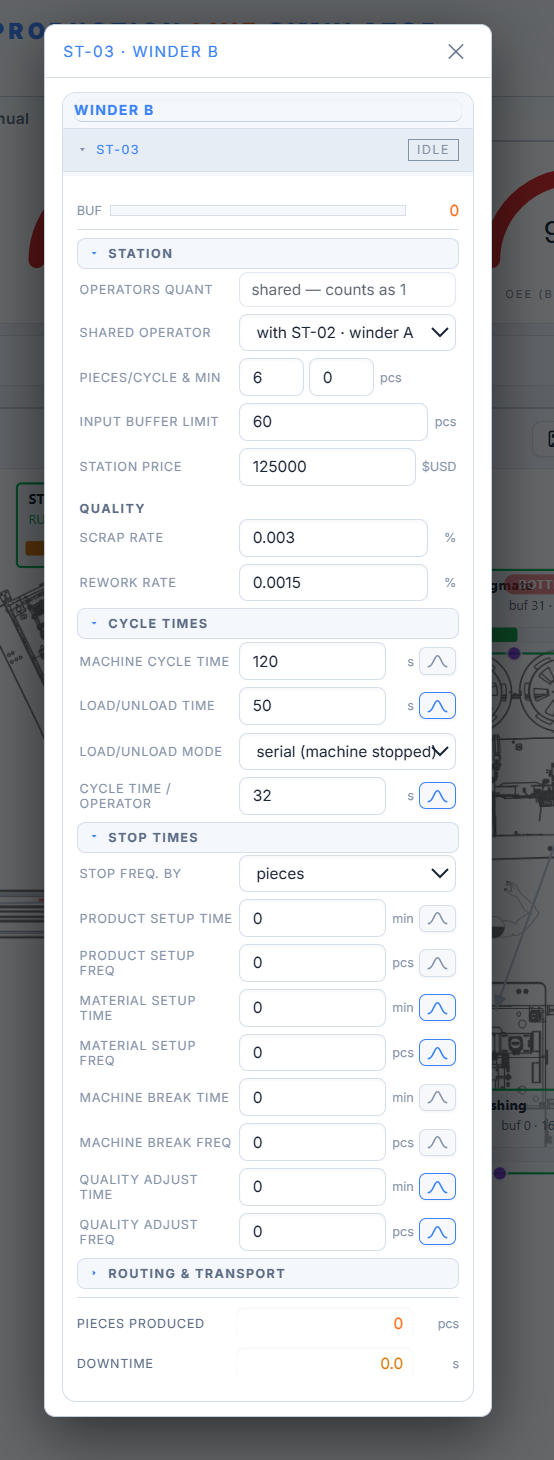
Lay out stations, parallel stages, buffers, conveyors, operators and component feeders — all configured in modals, no code. Press play and watch material flow, with jams, starvation and blocking in real time.
  • Station, buffer & feeder modeling — no drag-and-drop fuss
  • Multi-BOM feeders & multi-product recipes / campaigns
  • Operator occupancy & labor balancing
  • Live KPI dashboard + flow view
Station configuration — operators, buffers, quality, cycle and stop times

02Run with real variability

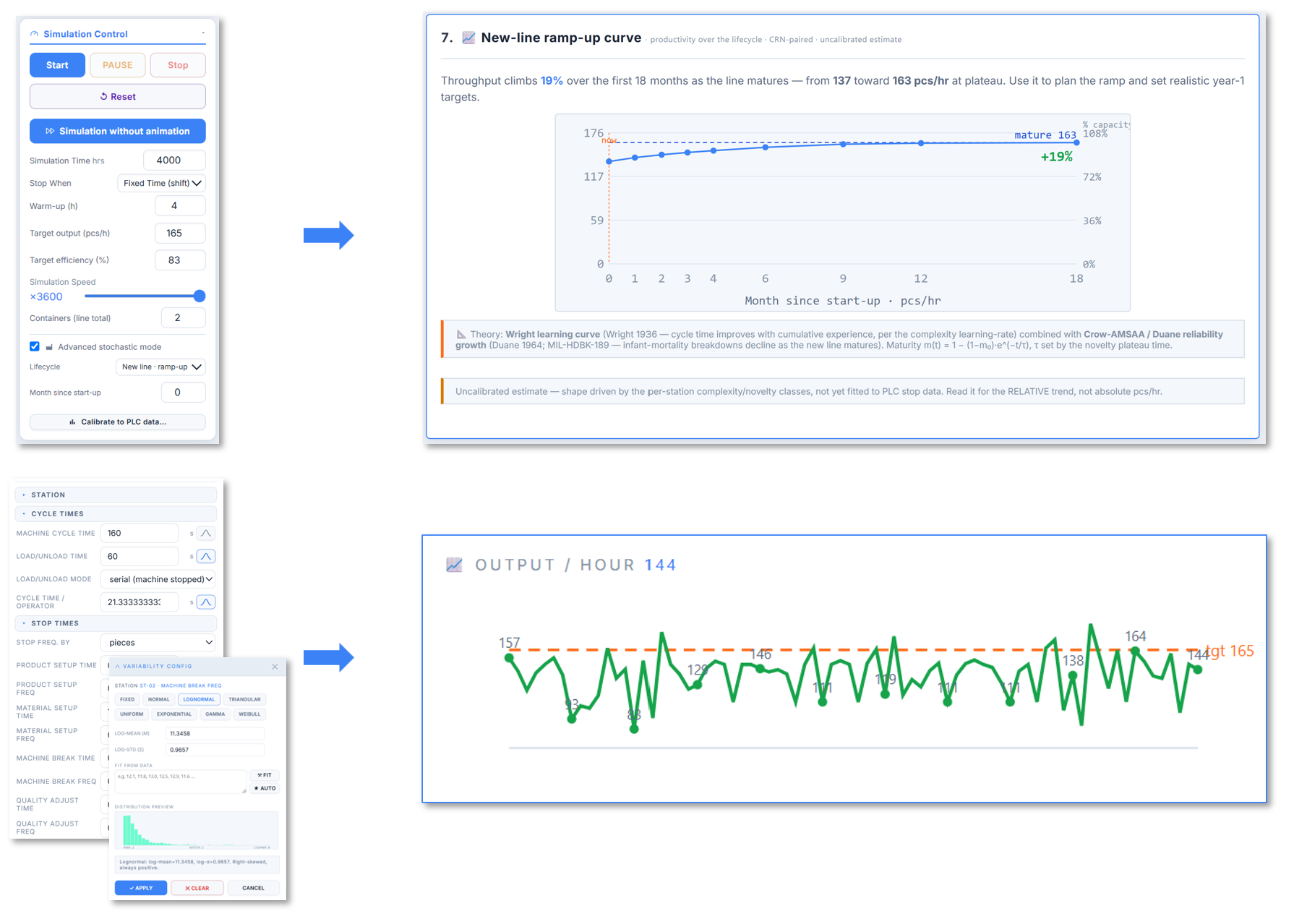
Watch flow, jams, starvation and blocking — or run without animation for speed. Statistical distributions on every cycle make it realistic, not deterministic, so the gap between the plan and reality shows up.
  • Statistical distributions on every timing input
  • Breakdowns, setups, scrap & rework
  • New-line ramp-up curve (learning + reliability growth)
  • Replications with 95% confidence intervals
Variability configuration, ramp-up curve and output per hour

03Compare & experiment

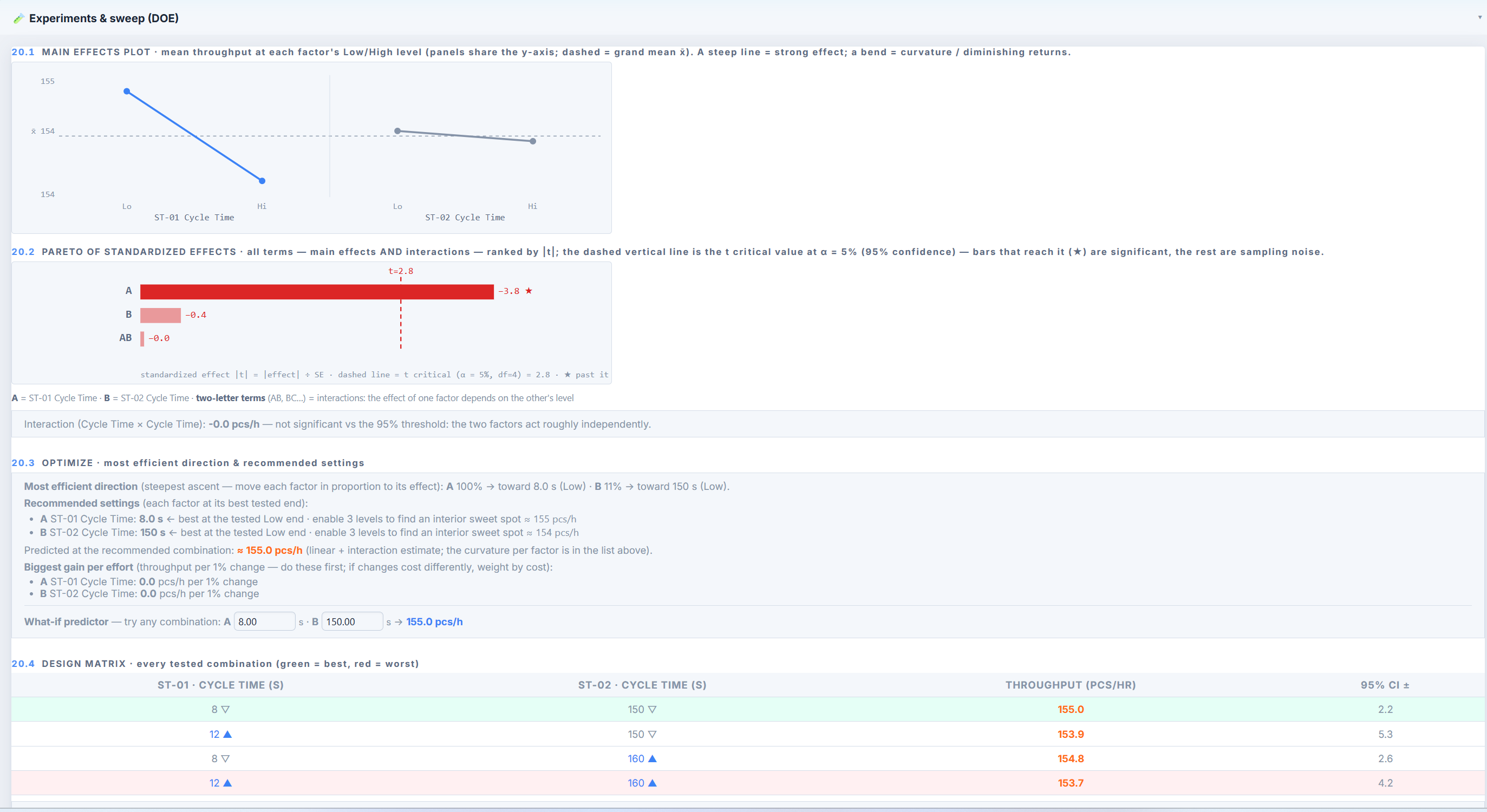
Set up scenario A vs B with common random numbers to isolate your change from luck, or sweep parameters with a full-factorial DOE to find the best configuration.
  • A×B compare with isolated payback
  • Factorial DOE + standardized-effects Pareto
  • Constraint-elevation advisory
Factorial DOE — main effects, significance Pareto and design matrix

04Decide with money

The executive one-pager and financial study price everything per year and tell you the payback — in the language your CFO already speaks. Exportable to PDF, CSV and Excel.
  • Loss waterfall in $/year
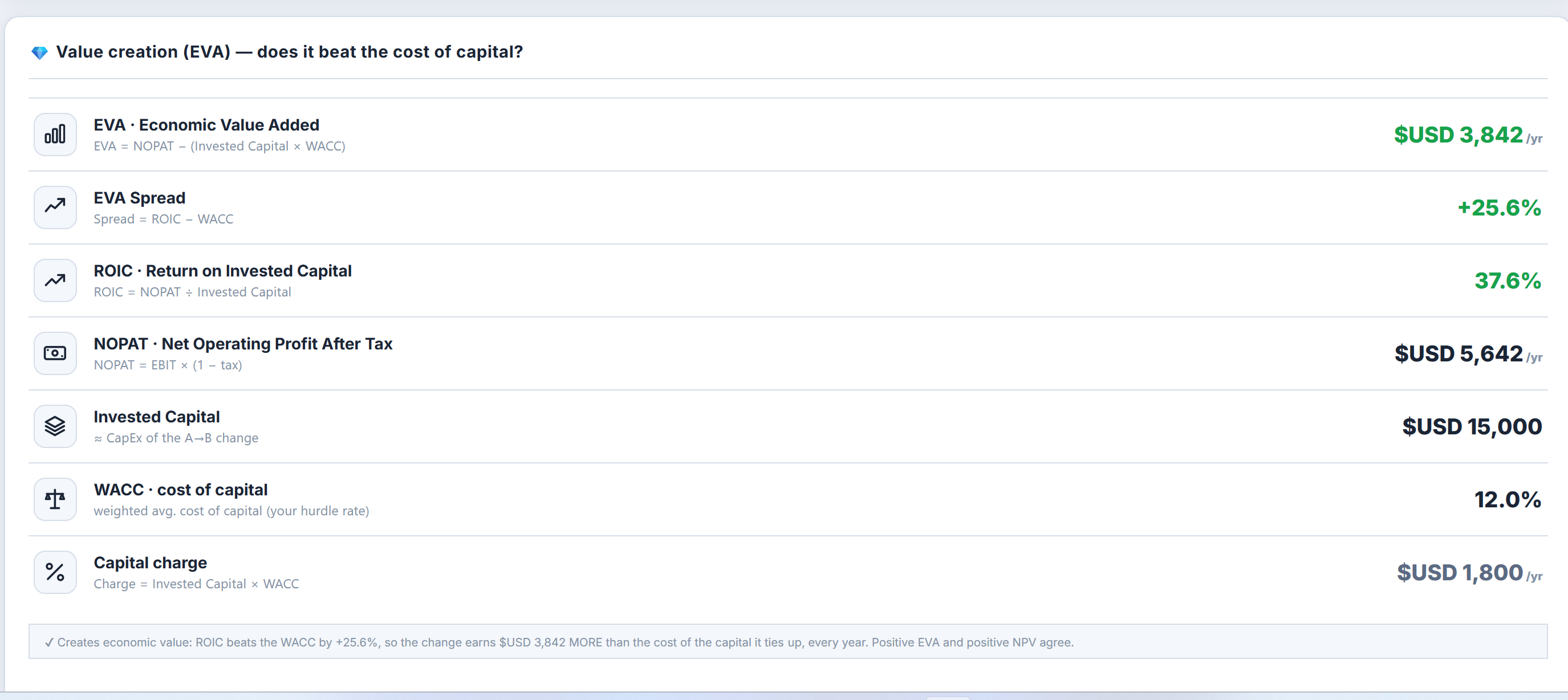
  • Payback · ROI · NPV · IRR · EVA · ROIC vs cost of capital
  • Executive 1-page PDF + CSV / Excel round-trip
Value creation — EVA, ROIC vs cost of capital
Why RASQI

Enterprise power without the enterprise price — or the specialists

Traditional line simulators are expensive, complex, and need a trained specialist to operate. Most small and mid-sized factories don't have one — and don't need one.

Heavyweight simulators

Powerful, but heavy

  • Thousands per seat, plus maintenance and modules
  • Weeks of training; a dedicated simulation specialist to run it
  • Paid consultants to build and maintain each model
  • Installed software, server licenses, IT overhead
  • Far more capability than most SME lines actually use
RASQI

Everything most lines need

  • $535 a year, everything included — no seats, no modules
  • Up and running in 10 minutes; basic line knowledge is enough
  • Build and change your own model — no consultant required
  • Runs in your browser — nothing to install, no IT project
  • The DES engine, bottleneck/OEE, DOE, scenario compare & payback you came for

RASQI is deliberately simpler — and for the vast majority of SME production lines, it fully covers the job. Anyone who understands the line can run a real simulation, without learning complex software.

Scope & fit

Built for flow lines — honest about the rest

RASQI is a focused discrete-event simulator for serial and assembly production lines, not a general-purpose modeling platform. That focus is why anyone who knows the line can run it in minutes — and it means some line types sit outside its scope. Here's the honest boundary, so you can tell before you buy.

Best fit — RASQI models this well

Serial & assembly flow lines

  • Serial stations and multi-BOM assembly (synchronized component feeders)
  • Parallel identical machines at a stage; finite buffers with real blocking & starvation; line-level WIP cap (CONWIP / pull)
  • Statistical variability (7 distributions), breakdowns, setups, scrap & rework
  • Multi-product recipes & campaigns with sequence-dependent changeovers
  • Shared operators with walk time, shift & break calendars, conveyors (incl. accumulating) & returnable-cart transport
  • Money-first output: OEE, loss waterfall, A/B compare, factorial DOE, payback · ROI · NPV · IRR · EVA
Outside scope — use a general-purpose simulator

Not the right tool for

  • Job-shop or arbitrary / probabilistic routing (a part choosing between different processes)
  • Re-entrant flows — a part revisiting an earlier station (e.g. semiconductor, PCB, plating, heat-treat)
  • Disassembly — splitting one part into several different outputs
  • Full per-stage kanban, and non-FIFO buffer priority (SPT / EDD)
  • AGV fleets and detailed vehicle material handling; secondary constrained resources (tools, fixtures, molds)

Your line somewhere in between? Tell us about it — we'll say honestly whether RASQI fits as-is, or scope a customization for your specific process.

The rationale
Start here · the purpose Make a better line decision — before the money is spent.

Buy a machine, add a shift, rebalance, expand — the expensive moves should be tested first.

Path A · Optimize Improve a running line → better financial results
1Model the line exactly as it runs today.
2Find the true bottleneck and price every lost hour in $/year.
3Test each fix as a paired scenario A→B — payback isolated from luck.
4Sweep parameters with DOE to land on the optimum.
5Sign off with ROI · NPV · IRR.
More throughput and margin from assets you already own.
Path B · Design Engineer a new line → hit the project target, balanced
1Model the proposed line (to-be), station by station.
2Balance it to takt so every station meets the target output.
3Size buffers, feeders and operators for smooth flow.
4Stress-test against real variability and breakdowns.
5Validate capacity and CAPEX before a machine is bought.
A right-sized line that meets the target — no over- or under-investment.

Try it on your own line — free for 30 days

Opens in your browser. No install, no card, no IT project.