Four tools · one licence · online · beta

Know before you invest — and measure it after.

The RASQI Line Simulator tells you what a production line will actually deliver, and prices every lost hour. It comes with the three tools that surround that answer: the statistics that say whether the data can be trusted, the business case that turns it into money, and the project tool that measures whether the gain showed up.

RASQI is in beta. The Line Simulator engine and report are in daily use and validated against queueing theory — what is still moving is the interface, the languages and the licensing. The other three products are online today and included; each is used on its own.

Runs in your browser  ·  Validated vs queueing theory ~2%  ·  No install, no IT project

rasqi — product preview
DEMO
Loading preview…
A guided preview of the real app. Watch full walkthrough ↗
The suite

Most tools stop at the approval. This one goes to "the gain showed up."

An improvement is a chain of four questions, and getting any one of them wrong wastes the other three. A capability study on a measurement system nobody trusts. A simulation fed by numbers someone guessed. A business case that was never checked against what actually happened. Each product owns one question — and only one. You buy the Line Simulator; the other three come with it, not as trial versions or feature-limited editions, but as the full products behind the same sign-in.

One front door — app.rasqintelligence.com

You don't juggle four logins and four bookmarks. Buying takes you to the RASQI Hub: one sign-in, and from there you open any of the four. It also shows the improvement cycle laid out, so you can see which product answers the question you have today.

It is a launcher and a map — deliberately not a dashboard. It never repeats a number another product calculated, because a figure shown away from the conditions that produced it is a figure waiting to be misread.

One question, one owner. Capacity comes from the simulator, statistics from 6Sigma Studio, the financial verdict from the Analyzer, the measured gain from the Project Manager. Whoever receives a number shows it — nobody recomputes it, because two implementations of the same calculation diverge, and they diverge on the hard case.
Today each product is used on its own and you carry the number across. The direct hand-off between them is being built; when it ships it will be announced here, not before.

Every claim on these cards was checked against the product's own source code or test suite before it was written here. Where a product doesn't do something, the Capabilities page says so.

The flagship · Line Simulator

A validated digital twin, money-first

Everything you need to model a line, find the constraint, and put a number on the payback — online, in your browser.

Discrete-event engine

Event-driven simulation of stations, buffers, parallel stages, conveyors and operators. Validated against M/M/1 queueing theory within ~2%.

Bottleneck & TOC

Identifies the true constraint, decomposes capacity, and applies Theory-of-Constraints reasoning to what to elevate first.

Loss waterfall & OEE

Breaks availability/performance/quality losses into a per-year money waterfall so you fix the expensive losses first.

Scenario A→B compare

Paired runs with common random numbers isolate your change from luck — and print its payback.

Full-factorial DOE

Parameter sweeps with main-effects, standardized-effects Pareto and a recommended optimum — plus an automatic improvement study that sweeps the two biggest losses and the constraint's cycle time.

Investment one-pager

Payback, ROI, NPV and IRR on a single page — turn an operations change into a financial decision. The full business case belongs to the Investment Analyzer, and the one-pager says so.

Multi-BOM feeders

Component feeder lines and multi-product recipes/campaigns model the real bill of materials, not just a single flow.

Statistical variability

Seven cycle-time distributions with auto-fit, plus breakdowns, jams, starvation and blocking — realistic, not deterministic.

Rewind the run

The recording travels as events, not frames — so you can speed up to 300×, pause, drag back and watch the same jam again at 1×, without asking the server anything.

Online, zero setup

Opens in any modern browser, always the latest version. The simulation runs on a secure server; your financial configuration — prices, margins, demand — is never sent.

See it in motion

From running line to money report

Two minutes, two parts: watch the simulation drive your line, then read the automated diagnosis that turns it into money.

rasqi — product film
FILM
How it works

From layout to money — in four steps

Model the line, run it with real variability, test your change, and read the payback. No code, no consultant, no install.

01Model the line

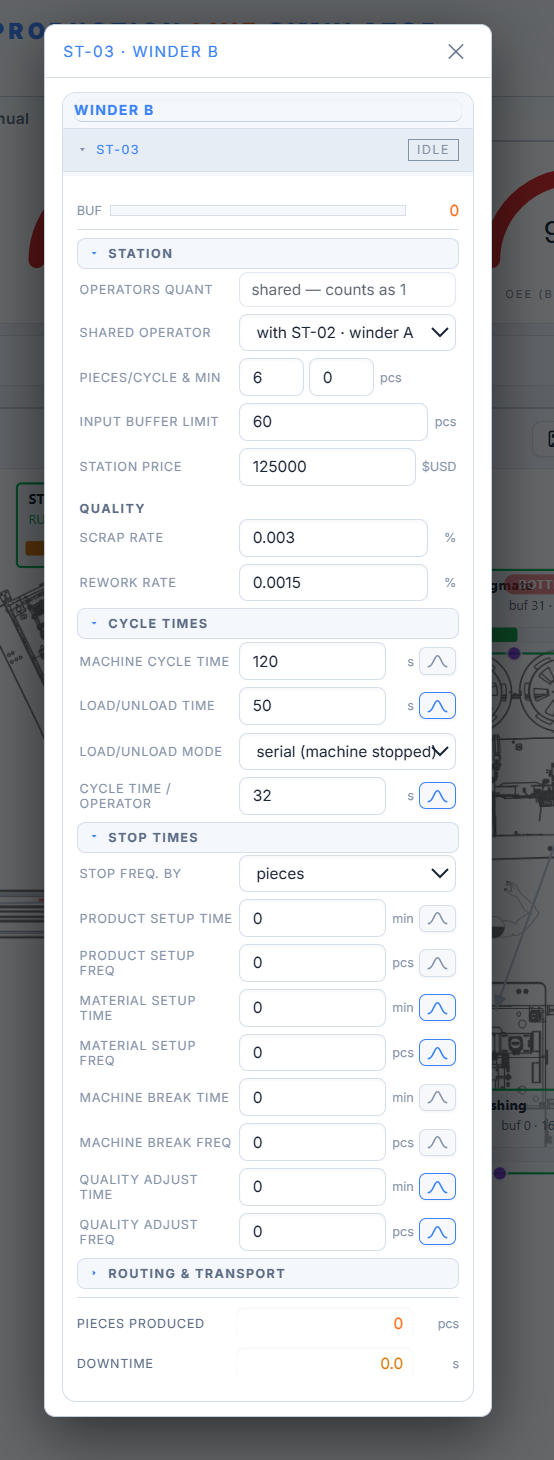
Lay out stations, parallel stages, buffers, conveyors, operators and component feeders — all configured in modals, no code. Press play and watch material flow, with jams, starvation and blocking in real time.

  • Station, buffer & feeder modeling — no drag-and-drop fuss
  • Multi-BOM feeders & multi-product recipes / campaigns
  • Operator occupancy & labor balancing
  • Live KPI dashboard + flow view
Station configuration — operators, buffers, quality, cycle and stop times

02Run with real variability

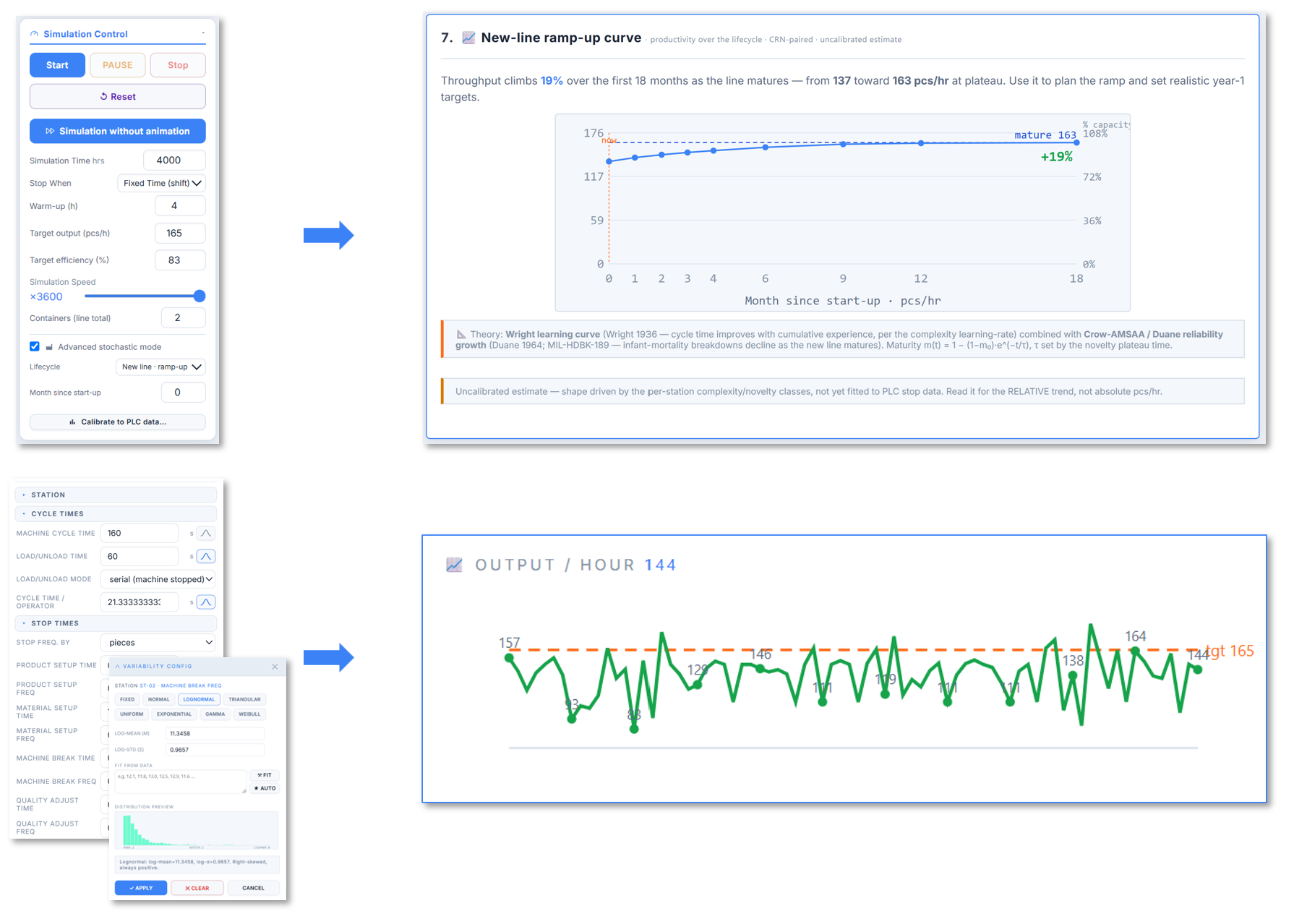
Watch flow, jams, starvation and blocking — or run without animation for speed. Statistical distributions on every cycle make it realistic, not deterministic, so the gap between the plan and reality shows up.

  • Statistical distributions on every timing input
  • Breakdowns, setups, scrap & rework
  • New-line ramp-up curve (learning + reliability growth)
  • Replications with 95% confidence intervals
Variability configuration, ramp-up curve and output per hour

03Compare & experiment

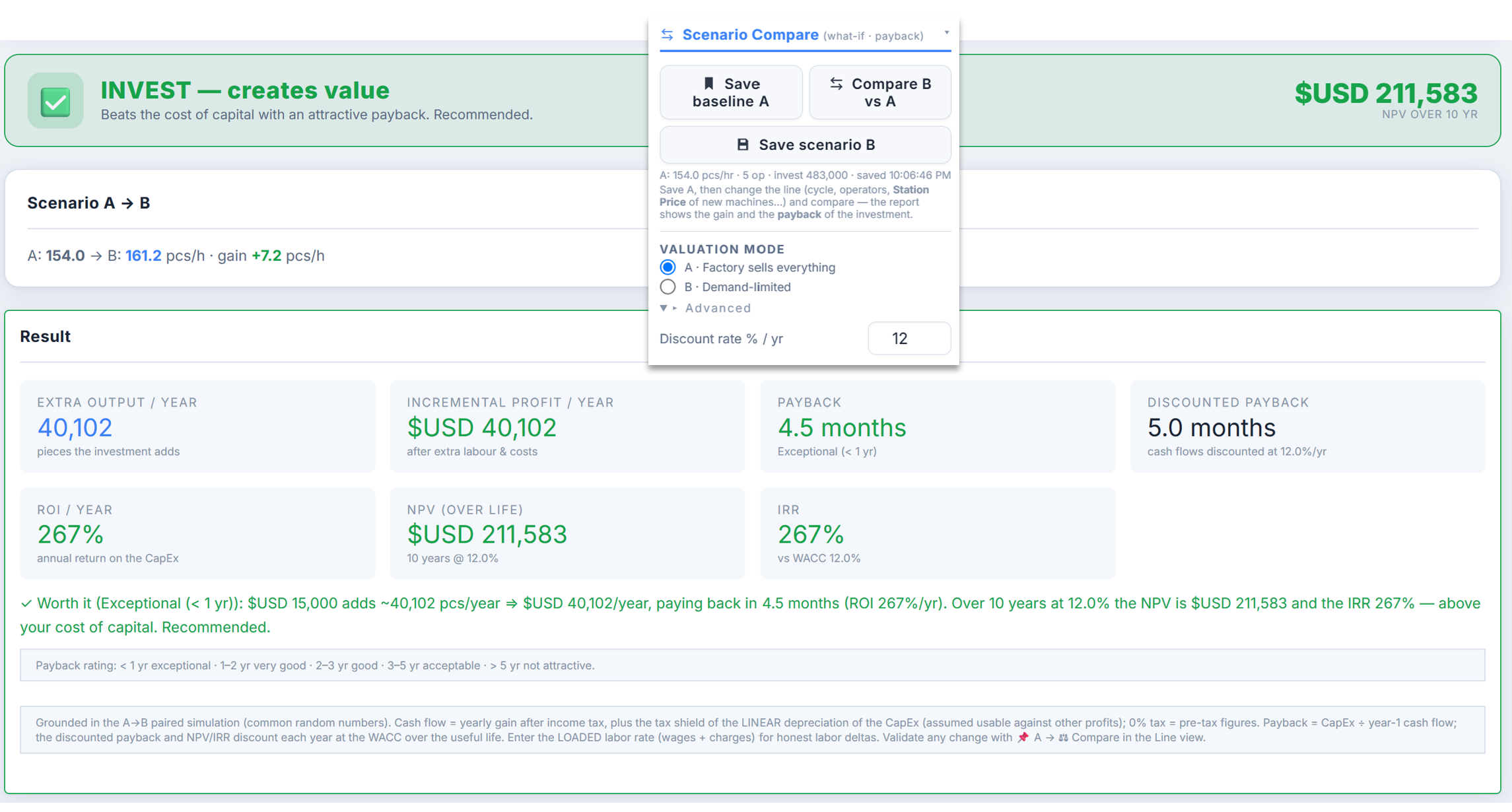
Set up scenario A vs B with common random numbers to isolate your change from luck, or sweep parameters with a full-factorial DOE to find the best configuration among those tested.

  • A×B compare with isolated payback
  • Factorial DOE + standardized-effects Pareto
  • Automatic improvement study: the response curve of each target, at the line's own horizon
Factorial DOE — main effects, significance Pareto and design matrix

04Decide with money

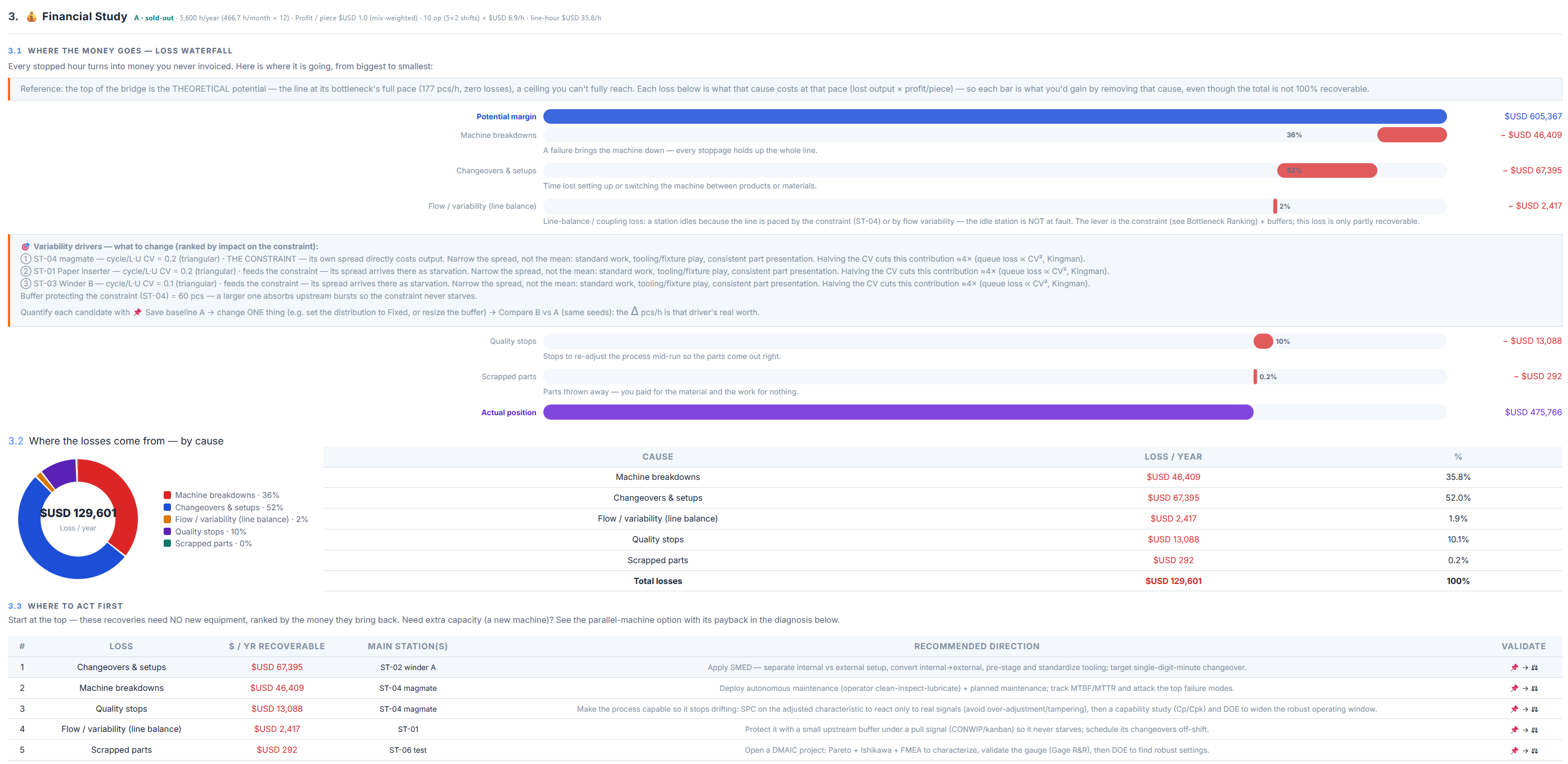
The executive one-pager and financial study price everything per year and tell you the payback — in the language your CFO already speaks. Exportable to PDF, CSV and Excel.

  • Loss waterfall in $/year
  • Payback · ROI · NPV · IRR · EVA · ROIC vs cost of capital
  • Executive 1-page PDF + CSV / Excel round-trip

The simulator says so itself: this is an engineering estimate for screening and prioritisation — it carries no working capital, no financing, no sales taxes, no inflation or FX, no ramp-up and no residual value. When the number has to survive an investment committee, that is what the Industrial Investment Analyzer is for, and it is in the box.

Value creation — EVA, ROIC vs cost of capital
Where it fits

Deliberately focused — and honest about where the focus ends

Traditional line simulators are expensive, complex, and need a trained specialist to operate. Most small and mid-sized factories don't have one — and don't need one. RASQI is a focused discrete-event simulator for serial and assembly production lines, not a general-purpose modeling platform. That focus is why anyone who knows the line can run it in minutes, and it means some line types sit outside its scope. Here's the honest boundary, so you can tell before you buy.

Heavyweight simulators

Powerful, but heavy

  • Thousands per seat, plus maintenance and modules
  • Weeks of training; a dedicated simulation specialist to run it
  • Paid consultants to build and maintain each model
  • Installed software, server licenses, IT overhead
  • Far more capability than most SME lines actually use
Best fit — RASQI models this well

Serial & assembly flow lines

  • $670 a year per user, all four products — no modules, nothing held back
  • Serial stations and multi-BOM assembly (synchronized component feeders)
  • Parallel identical machines at a stage; finite buffers with real blocking & starvation; line-level WIP cap (CONWIP / pull)
  • Statistical variability (7 distributions), breakdowns, setups, scrap & rework
  • Multi-product recipes & campaigns with sequence-dependent changeovers
  • Shared operators with walk time, shift & break calendars, conveyors (incl. accumulating) & returnable-cart transport
  • Money-first output: OEE, loss waterfall, A/B compare, factorial DOE, payback · ROI · NPV · IRR · EVA
Outside scope — use a general-purpose simulator

Not the right tool for

  • Job-shop or arbitrary / probabilistic routing (a part choosing between different processes)
  • Re-entrant flows — a part revisiting an earlier station (e.g. semiconductor, PCB, plating, heat-treat)
  • Disassembly — splitting one part into several different outputs
  • Full per-stage kanban, and non-FIFO buffer priority (SPT / EDD)
  • AGV fleets and detailed vehicle material handling; secondary constrained resources (tools, fixtures, molds)

RASQI is deliberately simpler — and for the vast majority of SME production lines, it fully covers the job. Anyone who understands the line can run a real simulation, without learning complex software. Your line somewhere in between? Tell us about it — we'll say honestly whether RASQI fits as-is, or scope a customization for your specific process.

Factory owners

Answer "will this investment pay back?" with numbers, not vendor promises — from a screening one-pager in the simulator to a full incremental business case in the Analyzer.

Process engineers

A validated DES engine (M/M/1 within ~2%) with TOC/Lean/Six Sigma diagnosis — and the statistics to check your inputs before you trust the output. No coding, no server of yours.

Zero IT overhead

Opens in any modern browser, always the latest version. Nothing to install, nothing to host — and your saved lines, cases and projects stay in your browser, not in our database.

Try it on your own line — free for a month

All four products, in your browser. No install, no card, no IT project. RASQI is in private beta, so access is by request while we finish it.